


This is one of the questions we were recently asked by a leading private equity firm, Sovereign Capital Partners, who manage close to $1bn in funds.
The honest answer is I don’t know and I highly doubt we’re on Guidewire’s radar. But the fact that we get asked this question by so many VCs, Guidewire customers and Insurtech Partners clearly implies that they see something different and potentially disruptive in an Insurtech Gateway Marketplace model.
So let’s take a look at the difference between a ‘Legacy Vendor + Eco-System’ vs a more modern ‘Insurtech Gateway Marketplace’.
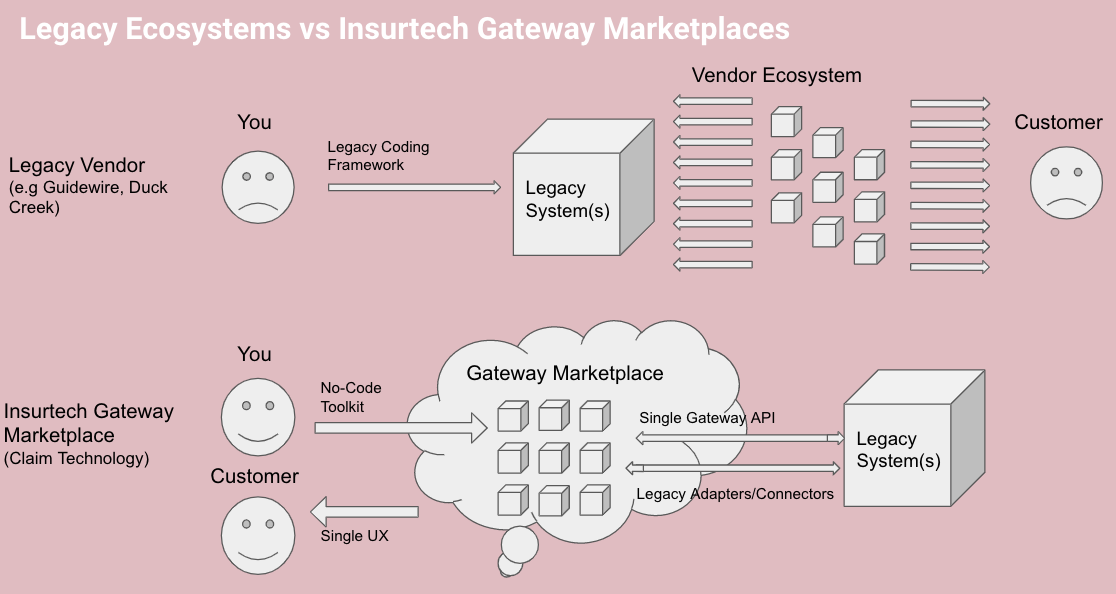
A key difference between the two is that the legacy vendor + ecosystem model is designed for the vendor to centralise it’s control and protect its commercial interests vis-a-vis the insurer or insurtech. The gateway model is the opposite, it’s designed to decentralise control for both the insurer and the insurtech with the gateway acting as a mere enabler, allowing both the insurer and insurtech to maximise their commercial benefit, and underpin a single user experience for the customer.
Key Differences for Insurers
| Legacy Eco-System | Insurtech Gateway | |
| Product-centric vs Customer Centric | Legacy platforms were designed for a ‘product-centric’ age where the process is designed around the insurer’s focus to control the flow of work and each part of the supply chain works in isolation to optimise its internal cost base. | Gateways are designed for a ‘customer-centric’ age where claims processes are experiences built around customer needs and where the inefficiencies between supply chain relationships are eliminated to eliminate friction and cost. |
| Freedom vs Vendor-lock | Legacy eco-systems are a defensive move by vendors seeking to protect their legacy business. This is a model designed to benefit the vendor. | Gateways are an enabling move to help insurers move from the drag caused by internal network effects to unleashing the innovation potential of an outside-in model. |
| Closed vs Open | Legacy eco-systems are a closed club so interesting insurtechs that may potentially overlap/compete with the vendor aren’t let in. | Gateways are open-house invitations and act as an industry kitemark to de-risk the infosec and compliance issues around testing or adopting promising but immature start-ups/scale-ups, creating a highly collaborative model designed to lift the insurance industry as a sector. |
| Pipelines vs Networks: | As insurtechs have to plug themselves into the legacy system, there is usually only one way that the service can be used, leading to standalone, dis-jointed insurance processes that aren’t customer-centric at all. | As gateways take responsibility for plugging in insurtechs, there is utmost flexibility and consistency in how that service can be consumed, from a pure proxy API for insurers to call from their own front-ends, to 1-Click marketplace solutions within which multiple insurtech services have been embedded to create a holistic plug & play solution that can be tested with real customers in minutes. |
| Cost vs Value | The high cost for insurtechs to integrate with the legacy eco-system means that the insurtechs that are available are those that are forced to mirror the legacy vendor’s sales approach, so you can expect multi-year contracts, higher transaction costs and minimum spend commits, resulting in poor value for money. | Gateways act as platform aggregators and are incentivised to maximise the transaction value between members. A gateway’s economy of scale means that tech buyers can often access insurtech services with no rolling contracts, no minimum spend commits and substantially reduced transaction costs. |
Key Differences for Insurtechs
| Legacy Eco-System | Insurtech Gateway | |
| High-barriers to entry | Legacy systems are renowned for the difficulty and complexity around integration. This requires the insurtech to bend it’s infrastructure, product design and skill-sets to accommodate, at enormous opportunity cost. | Gateways take responsibility for integrating with your product or service, requiring nothing more than you exposing a set of external APIs or SDKs. Not only does this avoid the cost of internal dev work around infrastructure changes, but your long-term product development costs are reduced by leveraging gateway functionality, so your runway is allocated to business development. |
| Financial risk | Insurtechs take on the entire financial risk in the speculative hope that sales will follow. Once you’ve been sold the dream, the legacy vendor can boast about their eco-system with no skin in the game at all. It’s the same dream they sell to their insurer clients, and you can expect similar results. | Gateways are incentivised to maximise transaction volume between gateway members, so their primary focus is your sale. Claim Technology are particularly generous in this regard, with no marketplace commissions and innovation funding awards to accelerate your go-to-market plans. |
| Product-fit | The prescriptive way in which you plug into a legacy eco-system means that you will be tied into further development work as you onboard every new client, which is the opposite of the scalable model your investors want to develop. | With a gateway you build a standard integration once and then let the gateway handle the complexity for insurers wanting to consume your service for different contexts, use cases or channels. |
Conclusion
As a pure-platform play, we don’t see ourselves as a competitor to Guidewire but as a collaborative force for good that creates a genuine win-win model and a better future for insurers, vendors and their customers. What do I think of Guidewire? I don’t know, they’re not on our radar.


