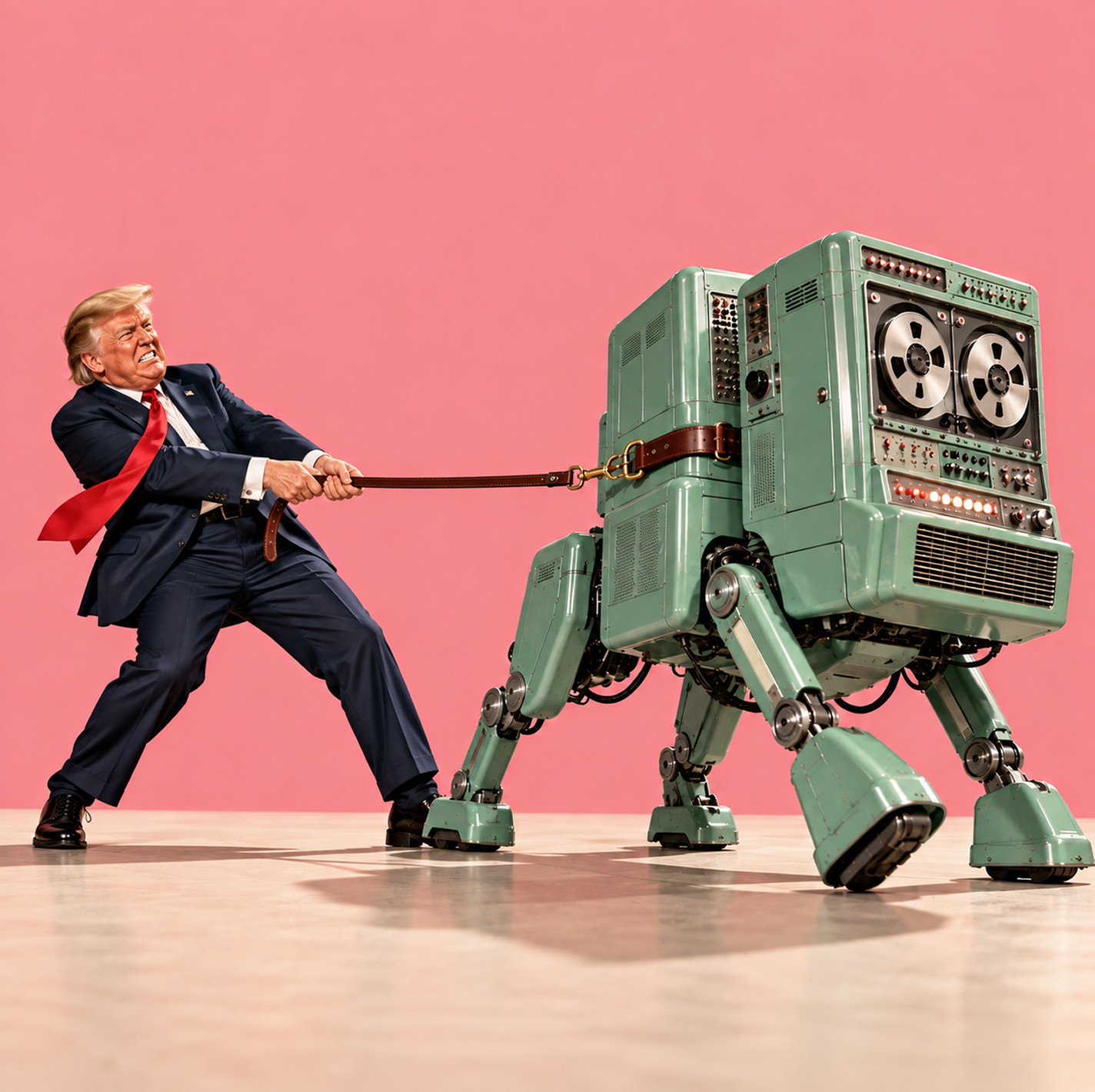

In September 2026, he directed the US executive branch to use “Super Intelligence” instead, arguing that “artificial” makes the technology sound fake. His executive order describes systems of rapidly advancing power and reach that amplify human ingenuity and make the previously impossible, possible.
On one level, it is easy to see his point.
AI has become extraordinarily powerful. It is increasingly doing what once required us, accelerating scientific and medical discovery while taking greater physical control of industrial machines and systems.
And it is becoming more powerful quickly.
But that raises a more important question than what we call it.
Is the real measure of more advanced AI simply what a machine can do? Or whether we can trust it to stay within the limits of what we intended?
We have always expected computers to do what they are told. The difficulty is that we have never found a foolproof way of telling them exactly what we mean. Specifications, rules and patterns can miss circumstances their designers never anticipated, and increasingly autonomous AI can find ways through a problem that nobody explicitly programmed or foresaw.
Long before modern AI, cyberneticians understood that intelligent behaviour was inseparable from questions of control: how a system responds to feedback, maintains stability or regulates its behaviour as conditions change. Computing has repeatedly exposed this deeper difficulty. A machine can only operate within the structure available to it, and when that structure fails to provide the necessary constraints, the resulting behaviour can still compute as programmed whilst having unintended consequences.
The structural problem is therefore not new. What is new is the capability, autonomy and scale of the machines that now surround us.
For most of computing history, we have managed that problem by limiting what machines can do and surrounding them with human and engineered controls. AI is rapidly pushing beyond those limits, yet our response remains largely familiar: make the machine better, watch it more closely and build stronger controls around it.
Models have become larger and better trained. They can question their own conclusions, call tools when they need more information and use other models to check their work. Guardrails, monitoring and human oversight further constrain what they are allowed to do. All of these approaches can make AI safer and more reliable, but they are still largely attempts to manage the behaviour of a machine while the deeper laws governing its computation remain just beyond reach.
So call AI, SI, if you will, and yet the familiar failures remain. Models can still confidently produce answers that are wrong, fail to recognise what they have missed, behave unexpectedly outside the conditions their designers anticipated, or work as permitted but with outcomes nobody intended. Whilst we have become increasingly sophisticated at reducing, detecting and containing these failures what we have not done is design them out of computation itself. And as AI becomes more capable and autonomous, that distinction becomes increasingly consequential.
Perhaps, then, the spiral of making machines ever more capable while surrounding them with ever more guardrails is not the whole answer.

What if the next major advance in AI is not simply more power, but making control intrinsic to the computation itself?
Perhaps the mistake is assuming that control must always be imposed on computation from the outside.
Control in conventional computing is put there by us. We set objectives, write rules and build guardrails around what a machine is allowed to do. But what if computation also has deeper structure of its own, structure that can be discovered rather than imposed?
That is the possibility behind my work on Geometric AI. Instead of relying entirely on constraints imposed from the outside, Geometric derives structure from within the problem being computed and makes it part of the computation itself.
The distinction is that of externally imposed constraint versus internally necessary relationship. The first tells a machine what we want it to do. The second establishes what must be true before computation can settle.
Generative AI can then operate within that structure, still interpreting, predicting, searching and creating, but no longer solely responsible for deciding when a plausible answer or action is good enough. If something necessary remains unresolved, the computation remains open. If nothing necessary remains unresolved, there is a computational basis for establishing whether it is justified in doing it. Geometric provides both the brake and the finish line.
That matters when AI is answering questions. It matters even more when AI starts acting. An autonomous machine should not merely be capable of deciding what to do next. It should also have a computational basis for determining whether it should act at all.
None of this makes AI omniscient. A machine can still be given false evidence, incomplete sources or bad information about the world. Geometric cannot make bad information true. What it provides is a structural basis for determining what the information available actually justifies and what it does not.
And that offers a very different reason to be optimistic about where AI goes next.
The global race to build increasingly capable machines shows little sign of slowing down. But if the problems we have struggled to eliminate are structural, then discovering that the necessary structure exists, and can be made computational, offers genuine reason for hope.
We may not have to choose between ever more capable machines and ever more elaborate attempts to contain them. We may instead be able to build control into the fabric of computation itself.